
Why Most Startup Platforms Crash (And How to Fix It)
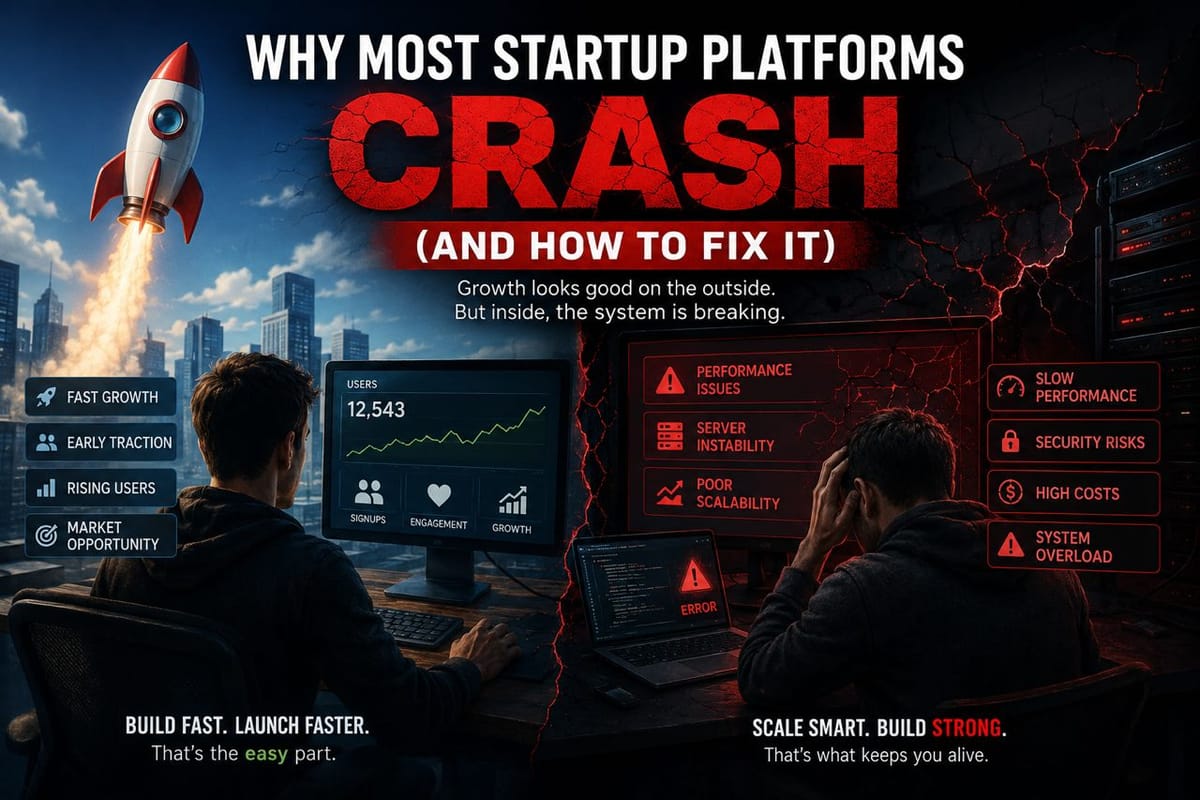
INTRODUCTION: A startup is a business designed to grow rapidly, usually by solving a problem through technology or innovation. Companies like Uber, Airbnb, and Stripe all began as startups before becoming global technology companies.
What makes startups unique is not simply their size, but their speed. Most startups are built to scale quickly, attract users rapidly, and expand into larger markets within a short period of time.
But growth creates pressure, one of the most common misconceptions in the startup world is that platforms fail only because of poor ideas or lack of funding. In reality, many startup platforms fail because they are not technically prepared for growth.
A platform may launch successfully, attract attention, gain users quickly, and even generate early traction yet still struggle internally with performance issues, infrastructure instability, poor scalability, security weaknesses, and increasing operational pressure. From the outside, the company appears to be growing.
Behind the scenes, the platform is slowly becoming difficult to maintain.
This pattern is far more common than many founders realize.
The issue is not usually a single catastrophic mistake. More often, startup platforms fail because small technical decisions made during the early stages begin compounding as the business grows. Many startups prioritize speed over structure in the beginning, which is understandable. Early-stage companies are under pressure to launch quickly, validate ideas, attract users, and compete in fast-moving markets.
But rapid development without long-term infrastructure planning often creates fragile systems.
At first, these weaknesses may not be visible. The platform works well with a small number of users, limited traffic, and a lean development environment. Problems only begin to appear when growth introduces more complexity.
Pages load more slowly.
Downtime becomes more frequent.
Database queries become inefficient.
APIs begin failing under pressure.
System monitoring becomes inconsistent.
Security vulnerabilities emerge.
What initially felt like “minor technical debt” gradually becomes a serious operational risk.
POOR SCALABILITY PLANNING:
One major reason startup platforms crash is poor scalability planning. Many platforms are built for launch-day traffic, not long-term growth. Infrastructure decisions are often based on what is cheapest or easiest during development rather than what can sustain increasing demand over time.
As traffic grows, systems that once functioned smoothly begin struggling under pressure. Servers become overloaded, deployments become risky, and application performance becomes unpredictable.
In some cases, startups respond by continuously adding more paid tools and cloud resources without addressing the underlying architectural issues. This temporarily delays the problem but often increases operational costs significantly without improving long-term stability.
Technical Monitoring is Another Area Many Startups Underestimate And Turn to Make mistakes.
A surprising number of growing platforms have very limited visibility into their own infrastructure health. Problems are often discovered only after users begin complaining.
Without proper monitoring systems, startups struggle to identify:
• performance bottlenecks,
• unusual traffic behavior,
• server instability,
• failed deployments,
• or security incidents early enough to respond effectively.
The absence of proactive monitoring turns small technical issues into major operational disruptions. Security is also frequently treated as something to address “later.”
Early-stage startups sometimes delay infrastructure hardening, access control management, credential protection, or backup strategies because they are focused primarily on growth and product development.
However, as platforms scale, security weaknesses become more dangerous and more expensive to resolve. A single infrastructure compromise or prolonged outage can damage customer trust significantly, particularly for platforms handling sensitive user data or financial transactions.
Another Overlooked Factor is Operational Complexity.
As startups grow, teams often adopt too many disconnected tools, services, and workflows. Over time, infrastructure becomes difficult to manage because every system depends on multiple external services working together correctly.
This creates environments where troubleshooting becomes slower, deployments become riskier, and technical maintenance consumes more time than actual product development. Ironically, the very tools intended to help startups move faster can sometimes become part of what slows them down later.
So how can startups avoid these problems?
The solution is not necessarily spending more money or building massive enterprise infrastructure from the beginning.
In many cases, the answer is building more intentionally.
Startups that scale successfully tend to prioritize:
• scalable architecture,
• infrastructure visibility,
• system reliability,
• operational simplicity,
• and long-term flexibility early in their growth journey.
This often includes adopting stronger DevOps practices, implementing monitoring systems, improving deployment workflows, reducing unnecessary technical dependencies, and designing infrastructure that can evolve gradually alongside the business.
Open-source technologies have also become increasingly valuable in this area because they allow startups to maintain greater control over infrastructure while reducing dependence on expensive proprietary systems.
More importantly, they provide flexibility. Startups can adapt systems to their own operational needs rather than forcing growth into rigid software ecosystems.
Of course, technology alone is not enough. Infrastructure still requires proper planning, maintenance, security management, and performance optimization. But the startups that survive long-term are usually not the ones that simply grow the fastest. They are the ones that build systems capable of supporting growth sustainably. Because in the end, platform stability is not just a technical issue.
It is a business survival issue.
Final Thoughts
Building a startup platform is no longer just about launching quickly. It is about building systems that can survive growth, scale reliably, and adapt to increasing operational demands over time.
Many startups encounter technical challenges not because their vision is weak, but because their infrastructure was never designed to support long-term scalability, stability, and efficiency. As platforms grow, issues related to downtime, performance, security, operational complexity, and rising software costs become impossible to ignore.
This is why technical infrastructure should be treated as a strategic business decision rather than simply a development task.
At Dohtech Solution, the focus is not only on helping startups build platforms, but on helping them build sustainable systems capable of supporting real growth. Through modern DevOps practices, scalable open-source infrastructure, proactive monitoring, performance optimization, and reliable technical support, startups can reduce operational pressure while maintaining flexibility and control over their technology stack.
The goal is simple: create reliable, scalable, and cost-efficient systems that allow startups to focus on innovation and growth without infrastructure becoming a limitation.
Because in the long run, successful startups are not only defined by how fast they grow — but by how well their systems are built to sustain that growth.