
Free Cloud Credits Aren’t Free: The Hidden Costs Startups Discover Too Late

Introduction: The Honeymoon Phase of Free Cloud Credits
For many startups, free cloud credits feel like a rite of passage. You sign up, get accepted into a startup program, and suddenly you have tens or even hundreds of thousands of dollars in cloud credits. In the early days, it feels like a win infrastructure decisions are no longer constrained by cash flow, teams can move fast, and experimentation feels virtually free.
This honeymoon phase is exactly what makes cloud credits so dangerous.
What starts as a temporary boost quietly shapes architectural habits, operational processes, and team behavior. By the time credits run out, many startups discover that their infrastructure costs are no longer optional, their systems are harder to change than expected, and their monthly burn has increased in ways that are difficult to reverse.
This isn’t a rare edge case. It’s a pattern.
An Improved Reality: Free Credits Shape Decisions Long Before They End
Cloud providers rarely force bad decisions. Instead, they remove friction at exactly the wrong time.
When infrastructure feels free:
- Teams stop right-sizing resources
- Engineers favor convenience over control
- Managed services quietly replace simpler primitives
- Cost visibility becomes an afterthought
None of these choices look unreasonable in isolation. In fact, many of them feel like best practices until the invoice arrives.
Founders Are Already Talking About This (Publicly)
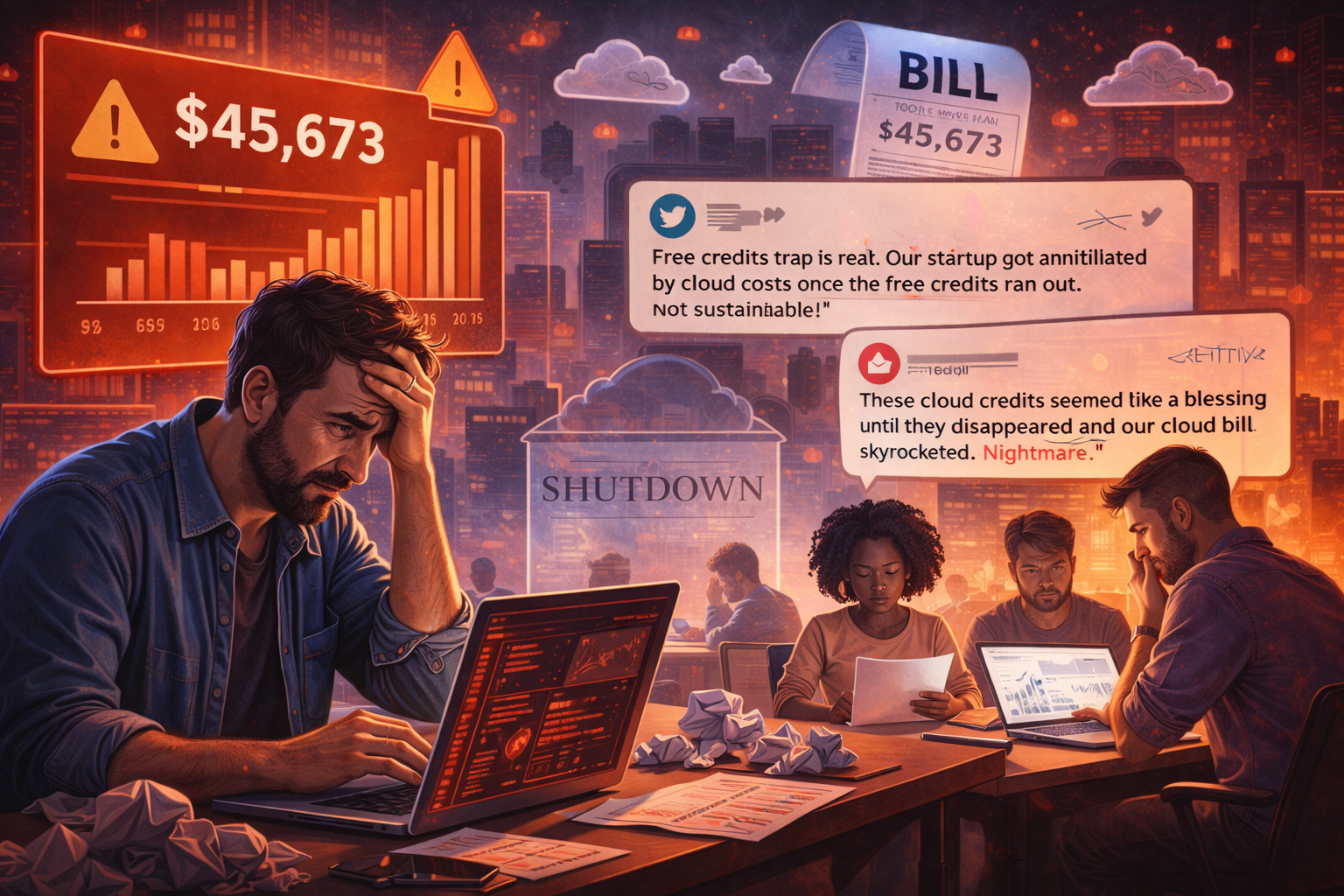
If you spend time on Twitter or Reddit, you’ll find founders openly sharing their frustration once credits expire. These aren’t anonymous edge cases they’re recurring complaints from people who did everything they were encouraged to do.
On Reddit (especially in communities like r/startups, r/devops, and r/aws), founders regularly describe the same shock: a cloud bill that suddenly jumps from near-zero to five figures overnight. One common post details a small SaaS team whose managed database, logging, and analytics costs quietly crept past $12,000/month after credits ended despite serving fewer than 5,000 active users. The founder’s frustration wasn’t about paying for infrastructure; it was realizing how little of it they truly understood or could easily change.
Another frequently upvoted complaint comes from early-stage founders who discovered they were paying thousands per month for Kubernetes clusters running at less than 20% utilization. During the credit phase, no one questioned it. Afterward, scaling down felt risky, and rebuilding felt overwhelming.
On Twitter (now X), similar stories surface in threads and replies: screenshots of unexpected bills, comments about "managed services quietly becoming permanent," and founders admitting they felt embarrassed asking peers how to unwind infrastructure choices they no longer felt confident touching.
The common theme across platforms isn’t poor engineering it’s that cloud credits normalize decisions long enough for them to become habits.
Realistic Cost Scenario #1: Unused and Forgotten Infrastructure
One of the most common post-credit surprises is unused infrastructure that quietly accumulated over time.
Typical examples include:
- Staging and QA environments running 24/7
- Old test clusters created for short-lived experiments
- Load balancers, snapshots, and reserved IPs left behind after pivots
- Data pipelines feeding dashboards no one checks anymore
During the credit phase, these resources don’t raise alarms. After credits expire, they become recurring line items that feel impossible to track down without a full audit.
The problem isn’t waste it’s invisibility.
Realistic Cost Scenario #2: Over-Provisioned Infrastructure Becomes the Baseline
Early-stage teams often size infrastructure for peak expectations rather than current reality. With free credits, the pressure to optimize simply isn’t there.
Common patterns include:
- Databases sized for future scale rather than current load
- Kubernetes clusters with far more capacity than needed
- High-availability configurations before the business requires them
Once traffic grows, these over-provisioned systems feel justified even if utilization remains low. Scaling down feels risky, and teams often lack the confidence or observability to right-size safely.
The result is infrastructure designed for a company the startup hopes to become, not the one it is today.
Realistic Cost Scenario #3: Managed Service Creep
Managed services are incredibly valuable when used intentionally.
The issue arises when they become defaults rather than decisions.
During the credit phase, startups often adopt:
- Fully managed databases
- Managed streaming platforms
- Proprietary monitoring and logging tools
- Vendor-specific identity, networking, or messaging services
Each service solves a real problem. Together, they create deep coupling with a single provider’s ecosystem.
When costs rise, startups discover that replacing these services isn’t a simple swap it requires data migration, application changes, retraining teams, and downtime risk. At that point, the startup isn’t choosing to stay it’s stuck.
Cash Flow Shock and the Loss of Optionality
The most damaging impact of free cloud credits isn’t the bill itself it’s the timing.
Credits often expire just as a startup enters a critical growth or fundraising phase. Suddenly, infrastructure costs compete directly with hiring, marketing, and runway extension.
For startups operating in regions where funding is scarce particularly across parts of Africa, Latin America, and Southeast Asia this shock can be fatal. Unlike Silicon Valley startups, many of these companies don’t have easy access to bridge rounds or emergency capital. A sudden $5,000–$15,000 monthly cloud bill can exceed revenue, let alone profit.
Founders in African startup communities have openly shared stories of shutting down products not because of lack of demand, but because cloud infrastructure costs became unsustainable once credits ended. In several cases discussed on regional forums and Twitter threads, teams attempted to downsize infrastructure only to discover their systems were tightly coupled to managed services they couldn’t easily replace.
Instead of pivoting or iterating, these startups were forced to make a binary decision: raise capital they couldn’t access, or shut down.
Even outside emerging markets, infrastructure decisions made during the credit phase limit a startup’s ability to pivot:
- Moving providers feels operationally risky
- Simplifying architecture feels like going backward
- Cost optimization becomes reactive instead of strategic
At this stage, startups are no longer in control of their infrastructure. The infrastructure is controlling them.
Why This Keeps Happening
This problem persists because cloud credits solve a short-term problem while creating long-term inertia.
Cloud providers optimize for adoption. Startups optimize for speed. Neither party is incentivized to slow down and ask how the system should look after the credits end.
Without intentional design, the path of least resistance becomes the path of highest cost.
How DOHTECH SOLUTIONS Helps Startups Avoid the Credit Trap
At DOHTECH SOLUTIONS, we work with startups and SMEs before, during, and after cloud credit programs and the difference is almost always architectural intent.
We help teams:
- Design credit-aware architectures that scale down as easily as they scale up
- Prefer open and portable primitives over deeply coupled managed services
- Build cost visibility and usage boundaries from day one
- Separate experimentation environments from production billing risk
- Create exit-friendly infrastructure that preserves leverage and control
The goal isn’t to avoid cloud credits. It’s to use them without letting them dictate your future.
How Founders Can Prepare for Life After Cloud Credits
The goal isn’t to avoid cloud credits it’s to outgrow them safely.
Founders who navigate this transition successfully tend to do a few things differently:
Design for the Post-Credit World Early
They ask a simple question early on: What does this system look like when we’re paying for it ourselves? This mindset leads to smaller, more modular architectures that can be scaled down as easily as they scale up.
Adopt Open Source Intentionally
Rather than outsourcing every layer of the stack to managed services, successful teams adopt open-source technologies for core components databases, observability, CI/CD, and infrastructure automation. This builds internal understanding and reduces long-term dependency on proprietary platforms.
Managing open-source tools isn’t about doing everything manually. It’s about owning the operational knowledge required to adapt when costs or requirements change.
Build Operational Experience, Not Just Features
Teams that invest time in understanding how their systems behave resource usage, failure modes, scaling characteristics are far better positioned to optimize costs without fear. This experience compounds over time.
Partner Strategically, Not Transactionally
Not every startup needs to build deep infrastructure expertise in-house immediately. What matters is having a partner who designs systems with exit paths, trains teams gradually, and supports transitions instead of creating dependency.
This is where a technical partner can make the difference between surviving the post-credit phase and being trapped by it.
Free Credits Should Buy Learning, Not Lock-In
Used well, cloud credits are powerful. They should fund experimentation, validate assumptions, and accelerate early progress.
Used carelessly, they train teams into habits that are expensive to unlearn.
The startups that survive and scale are rarely the ones with the most generous credits they’re the ones that understand their infrastructure deeply enough to change it when the business demands it.
Final Thoughts
Free cloud credits aren’t a gift. They’re a test.
They test whether a startup can move fast without giving up control, convenience without lock-in, and growth without sacrificing optionality.
DOHTECH SOLUTIONS exists to help startups and SMEs pass that test by building infrastructure that remains flexible, understandable, and financially sustainable long after the credits are gone.
If you’re planning your next phase of growth, the right time to think about this is before the credits run out not after.